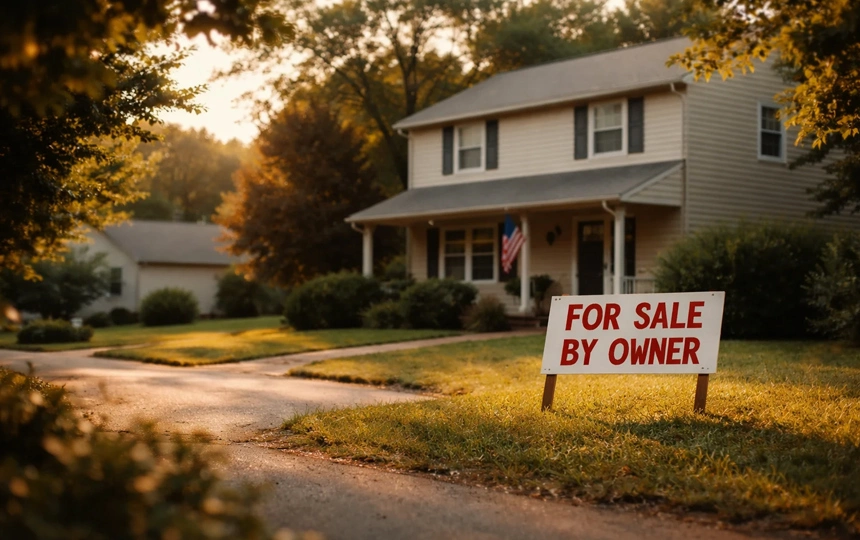
The first FSBO sold in eleven days for $4,200 less than what my agent would have netted me after commission. The second FSBO sat for three weeks, generated zero offers, and I ended up listing with a discount broker who took 1.5% and closed it in sixteen days. Same market, same price range, same kind of house. Two wildly different outcomes. FSBO turned out not to be the decision I thought it was.
The FSBO math most guides get wrong
Every FSBO calculator on the internet starts with the same equation. Take your list price, multiply by the commission you would have paid, and that is your savings. On a $400,000 house at 6 percent, you just “saved” $24,000.
Except the equation is missing at least three line items, and depending on how your local market behaves, missing any one of them can flip the math against you.
The first is pricing accuracy. FSBO sellers on average list for less than the comps would support. Part of it is that most FSBO sellers do not have access to the same comp data an agent does, and part of it is the caution that shows up when you are the one answering the phone at 9pm about whether you would take $8,000 less to close this week. A 2 percent underprice on a $400,000 house is $8,000 of “commission savings” you never actually banked.
The second is buyer reach. Agent-listed homes get syndicated through the MLS to Zillow, Redfin, Realtor.com, and regional brokerage sites within a few hours. FSBO listings can get there through flat-fee services, but you are still the one fielding showings, answering questions, and scheduling tours. You can do the work. The question is whether your deal pipeline is thick enough to generate multiple offers within a reasonable window.
The third is negotiation. Buyer agents negotiate for a living. When one pushes back on your price, they are doing it with repetition behind them, and most FSBO sellers do not have that muscle. A $4,000 concession you gave up because you were not sure how to push back is another line against the commission savings.
What the 2024 NAR settlement actually changed for FSBO
In August 2024, the National Association of Realtors settled a major antitrust lawsuit. The practical change most sellers noticed was on the buyer-agent side: cooperating buyer-agent commissions are no longer advertised in the MLS, and buyers now sign a written agreement with their agent before touring homes. The NAR’s consumer explainer on the settlement walks through what changed and when. For a deeper breakdown of what the settlement means for sellers, see our dedicated article.
For FSBO sellers specifically, this means two things worth understanding.
First, you have more flexibility. Before the settlement, the practical convention was offering 2.5 to 3 percent to a buyer agent as a cooperating commission, effectively standardized through the MLS. That pressure is gone. You decide whether to offer a cooperating commission at all, and if so how much, and you negotiate it directly as part of each offer.
Second, you have a new question to answer. Many buyers are now on the hook for their own agent’s fees if the seller does not cover them. Some of those buyers will walk past your FSBO listing because they cannot afford both a down payment and an agent commission out of pocket. If you want those buyers in your pool, you need to decide up front what portion of their agent’s fee you are willing to cover, and you need to say so clearly in the listing.
My second FSBO was in a slower market, and part of what killed it was that I had not made that decision cleanly. Buyer agents were showing their clients other listings where the cooperating offer was explicit, because it was simpler to work into the new buyer-agency agreements. I was effectively invisible to a slice of the demand pool for about three weeks, and by the time I figured out what was happening, the listing was stale enough that I listed with a discount broker instead.
When FSBO is the right call
There is a version of FSBO that works. The first time I sold FSBO, it worked for three specific reasons:
- The price was at the comp band, not 3 percent above it because I was emotionally attached to the house
- The local market had enough buyer demand that my listing did not need much help being seen
- I was genuinely comfortable handling direct contact with strangers about the house, including the uncomfortable calls
If all three of those are true in your situation, FSBO can make sense. If any one of them is shaky, it probably does not. The second sale of mine taught me that the three weeks I spent refreshing my own Zillow view count was actually the strongest signal of the month that I needed to list.
What I’d skip entirely
If you are weighing FSBO, here is what I would not spend time on.
FSBO “coaching” programs that promise to walk you through the process. Most of what they sell is available for free in the CFPB’s consumer home-buying hub and on your state’s real estate commission website.
Flat-fee MLS services that upsell “premium syndication bundles.” You want the basic MLS listing. Zillow, Redfin, and Realtor.com pick it up automatically within hours through standard IDX feeds. The premium bundles are reselling something you are already getting.
Taking your own listing photos “to save money.” A $350 professional photographer on listing day is one of the lowest-cost, highest-return line items in the entire sale. Do not shoot the listing with your phone.
“Pricing it high and coming down.” It sounds strategic. In practice, days-on-market is one of the signals buyers and their agents watch most closely, and a listing that sits for a few weeks starts accumulating a stigma that price reductions do not always fully repair.
The version you will get
The FSBO question is not really a question about commission percentages. It is a question about which parts of selling a house you actually want to handle, and whether you are the kind of person who can tell yourself the truth about which parts you are any good at. My first FSBO was cheap because I was lucky. My second was expensive because I was stubborn. When I hear sellers talk about “saving the commission,” I try to remind them that the commission is one line item in a sale that has about twelve moving parts, and the line items you cannot see tend to be the ones that decide the outcome.